
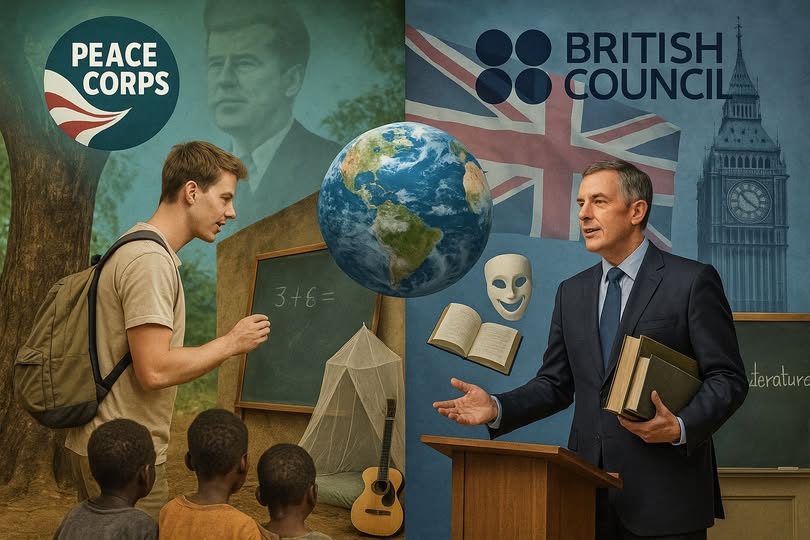
The US Peace Corps vs The British Council: A Tale of Service and Soft Power
When President John F. Kennedy founded the United States Peace Corps in 1961, he presented it as a call to action. “Ask not what your country can do for you, ask what you can do for your country,” was more than a stirring line from an inauguration speech – it became the driving ethos of a programme that would send young Americans to teach, build, and serve in communities far beyond their own borders.
The Peace Corps quickly became part of American identity abroad: an emblem of service, curiosity, and exchange. Volunteers embedded themselves in villages, schools, clinics, and farms, often learning local languages and living simply alongside the people they aimed to help. At its best, the work was grassroots – literacy projects, health education, agricultural innovation. At its most profound, it was about relationships: building trust and respect between Americans and communities from Africa to Asia.
Yet the Peace Corps was never only humanitarian. It was also political. It showed the world that Americans were willing to serve, not simply sell. In the context of the Cold War, this mattered. The presence of volunteers in rural corners of the globe served as an alternative narrative to Soviet influence. The Peace Corps thus embodied both idealism and pragmatism: genuine service and a strategic projection of values.
Compare this to the British Council, the United Kingdom’s long-standing cultural and educational arm, established in 1934. Where the Peace Corps is personal and volunteer-led, the British Council has been institutional and state-supported. Its mandate is to promote British culture, language, and education overseas. From language teaching centres in Madrid to arts partnerships in India, the British Council’s work has carried a softer, more academic flavour. It is less about digging wells and more about teaching English, sponsoring exhibitions, and brokering scholarly exchange.
The British Council operates in the register of “soft power” as coined by Joseph Nye: persuasion through culture and ideas, rather than force. Its motivations have long been tied to maintaining Britain’s international influence, especially in the wake of empire. The British Council’s carefully curated exhibitions, English-language schools, and cultural diplomacy projects ensure that Britain remains relevant in minds and markets worldwide.
So what’s the difference?
The Peace Corps is built on the energy of individuals who commit two years to live abroad, driven by a mix of idealism, adventure, and a desire to serve. It is deeply American in its spirit: rugged, people-focused, sometimes messy, but powered by conviction.
The British Council is structured, professional, and deeply tied to the state’s strategic interests. Its staff are not “volunteers” in the Peace Corps sense but career professionals. It is quintessentially British in its tone: polite, cultural, quietly persistent, and strategic in projection.
In truth, both organisations are mirrors of their nations. The Peace Corps reflects America’s missionary spirit – an optimistic belief that one person can make a difference in a village on the other side of the world. The British Council reflects Britain’s diplomatic instinct – a recognition that culture and education are powerful levers in maintaining presence on the global stage.
One builds classrooms; the other fills them with English. One carries a guitar and notebook; the other a curriculum and policy paper. Both are tools of influence, though forged from different national characters.
As the world enters new eras of competition – digital, ecological, ideological – the question is not which model was better, but what both could become. For in a fractured globe, the need for exchange, service, and trust remains as urgent as ever.
M. B. SHAW