
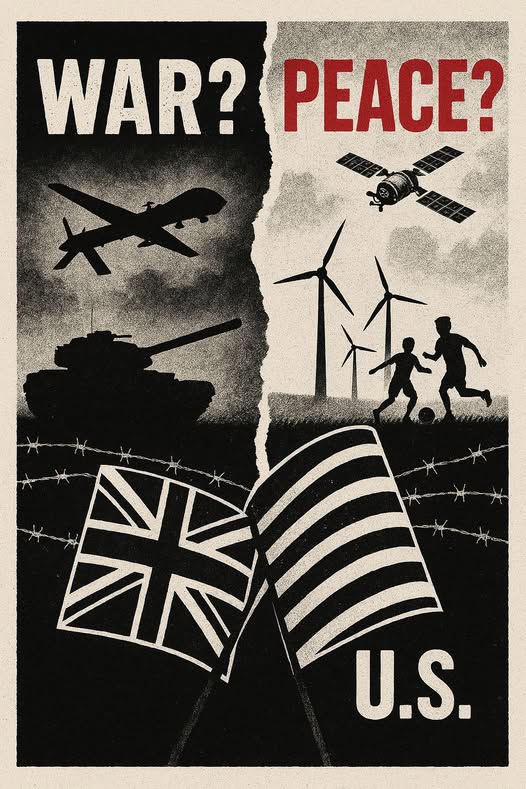
America, Musk, and Britain’s Labour Experiment: War, Peace, and the World to Come
By M. B. Shaw for The Dale Blues
The United States has always wrestled with its dual role as protector of liberty and pragmatic power in an uncertain world. Today, that tension is refracted through the lens of Elon Musk’s bold — sometimes eccentric — concepts about the future of America’s global role. His argument is simple: the U.S. should assist Britain to grow with success and clarity, not merely for nostalgia of the “special relationship,” but as a strategic investment in a stable, forward-looking partner.
From Washington’s perspective, the administration recognises the enduring value of the Anglo-American bond. Britain remains the world’s sixth-largest economy, a nuclear power, and a cultural beacon. Yet under Sir Keir Starmer’s Labour leadership, Britain is recalibrating its stance: less flamboyant than the Johnson years, more sober than Sunak’s fragile technocracy, but still struggling with the ghost of Brexit. For America, the calculus is clear. A Britain that is stable, growing, and diplomatically relevant is a Britain worth backing.
Musk’s vision, though often treated as futurist rhetoric, resonates with U.S. strategic thinking. A technologically driven Anglo-American bloc, tied by shared innovation and industrial renewal, could prove decisive in steering the Western alliance away from decline. Musk points to space, AI, and clean energy as the new battlefields of influence. Washington, cautiously, sees opportunity. London, under Starmer, hesitates but listens.
Yet beneath the talk of growth and clarity lies the darker undercurrent: war and peace. This planet, more interdependent and combustible than ever, stands at a crossroads. U.S. policymakers know that the conflict in Ukraine, the unpredictable tremors from China’s rise, and the chaos of Middle Eastern politics all converge on Europe’s doorstep. In such an environment, Britain’s leadership will be judged not by Labour’s domestic promises, but by its ability to align with America in safeguarding democratic stability.
The likelihood of war cannot be ignored. The return of conscription debates in Europe, military aid packages flowing across the Atlantic, and the fragile nuclear balance all signal the obvious. Yet the probability of peace remains real too — not through naïve hope, but through a united, technologically advanced Western partnership that fuses American dynamism with British pragmatism.
So the American administration’s position is as paradoxical as Musk himself: audacious in rhetoric, cautious in application. They see in Starmer’s Britain a partner that must not stumble, but also one that must prove it can lead. Musk provides the vision, Starmer provides the test, and Washington provides the guarantee. Whether this trinity yields war or peace depends on choices made now, in the silence between summit meetings, behind closed doors, and across the restless oceans that still bind us.