
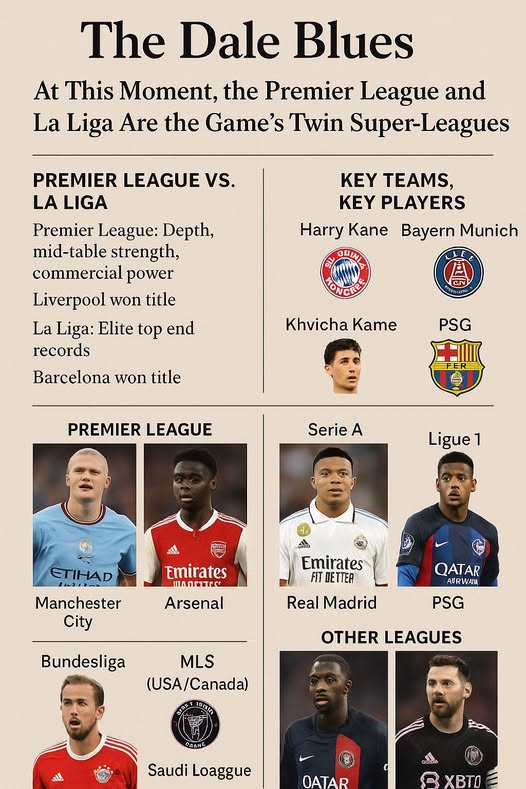
At This Moment, the Premier League and La Liga Are the Game’s Twin Super-Leagues
By TDB Sport Desk — analysis, context, and a few hard numbers to cut through the noise.
The case in one breath: England’s Premier League has the deepest week-to-week quality and commercial muscle; Spain’s La Liga boasts the most formidable top end. In 2024–25, Liverpool retook England, Barcelona reclaimed Spain, English clubs hoovered up two of three UEFA trophies, and Real Madrid’s star power—now turbo-charged by Mbappé and Bellingham—kept Spain at the summit of elite talent and revenues. Together, they’re the sport’s twin super-leagues.
—
Europe is the judge—and England & Spain are passing the exam
Start with silverware. England claimed two of UEFA’s three men’s titles last season: Tottenham won the Europa League in Bilbao and Chelsea captured the Conference League in Wrocław. Paris Saint-Germain smashed Inter in Munich to take the Champions League, but the spread of trophies still underlines the Premier League’s breadth.
Domestically, Liverpool sealed the Premier League on 27 April 2025, a landmark second PL era title and a record-tying 20th English crown. In Spain, Barcelona edged back to the top in 2024–25.
UEFA’s new “league-phase” format adds another tell: based on last season’s country performance, England send six teams to the 2025/26 Champions League and Spain five—a reflection of sustained results in Europe.
—
Depth vs. elite: how the two super-leagues differ
Premier League depth. The English top flight remains the toughest weekly exam. A mid-table side can punch Champions League calibre one weekend and scrap for points the next; the league’s commercial model keeps the middle class strong. Deloitte’s 2025 Money League shows five Premier League clubs in the global top 10 and a long tail of English teams deep in the top 30—commercial evidence of the depth we see on the pitch.
La Liga’s elite. Spain’s top end is outrageous. Real Madrid now field a frontline of Kylian Mbappé, Jude Bellingham and Vinícius Júnior; Mbappé finished 2024–25 as Pichichi and the European Golden Shoe winner (31 league goals). Beside them, Barcelona’s title—propelled by youth like Lamine Yamal—signals a renewed arms race at the very top. Financially, Real Madrid became the first club ever to record €1bn revenue in a season, underscoring La Liga’s elite draw.
Verdict: England’s middle class is stronger; Spain’s aristocracy is unmatched. Together, they set the global bar.
—
Key teams, key players—league by league
Premier League (England)
Liverpool are champions again under Arne Slot. The Reds’ structure plus Anfield’s edge made the difference in a year when City and Arsenal pushed.
Chelsea parlayed squad regeneration into tangible European success (UECL), while Tottenham’s Europa League run showed how English clubs can underperform domestically yet still go the distance on the continent.
Star power: Erling Haaland and Phil Foden remain City’s cutting edge; Bukayo Saka and Martin Ødegaard headline Arsenal; Cole Palmer has become Chelsea’s end-product merchant.
La Liga (Spain)
Barcelona’s title win hands the baton back in the clásico narrative; Lamine Yamal is not hype—he’s a weekly problem.
Real Madrid are galácticos 3.0. Mbappé’s Golden Shoe season plus Bellingham’s all-court dominance and Vinícius’ chaos give Madrid Europe’s most terrifying trio—and the bank balance to match.
Bundesliga (Germany)
Bayer Leverkusen broke Bayern’s hegemony in 2023–24; in 2024–25 Bayern roared back to claim the title with Harry Kane retaining the Torjägerkanone. The league’s player development pipeline (Wirtz, Musiala, et al.) keeps it close to Spain and England on any given European night.
Serie A (Italy)
Napoli reclaimed the Scudetto in 2024–25—a reboot for a league that keeps rebounding in Europe (Inter’s relentless consistency; Juve’s revival). Khvicha Kvaratskhelia remains appointment viewing.
Ligue 1 (France)
PSG won the Champions League in a statement 5–0 final—validation of a more balanced project post-Mbappé, with creators like Ousmane Dembélé and midfield control adding steel. Domestically they went back-to-back in 2024–25.
Eredivisie (Netherlands)
PSV retained the title amid a wild late-season swing, a reminder that the Dutch system remains a developer of both coaches and players.
MLS (USA/Canada)
Inter Miami’s Messi era re-rated the league’s ceiling, but Seattle Sounders won the 2025 Leagues Cup—depth and coaching matter as much as stardom in a parity-driven league.
Saudi Pro League
Massive spending turned heads; Al Hilal dominated 2023–24, while Cristiano Ronaldo’s Al Nassr remained box-office. The football’s improving, but week-to-week competitive churn and European-calibre depth still lag England and Spain.
—
Money talks—and it’s bilingual
Deloitte’s 2025 report crowned Real Madrid the first €1bn-revenue club, but the table around them reads like a Premier League roll-call: Manchester City, Manchester United, Arsenal, Liverpool, Tottenham, Chelsea—all in the global top 10. That duality—Madrid/Barça’s financial galaxy + England’s broadcast heft and commercial sprawl—explains why these two leagues hoard talent.
UEFA’s allocation for 2025/26 (six English clubs, five Spanish) bakes in more big-match nights, more TV weight, more prize money—a flywheel effect that sustains dominance.
—
The world stage rubber-stamp
If you wanted a one-tournament snapshot of where power sits, the expanded FIFA Club World Cup 2025 in the U.S. delivered it: Chelsea beat PSG in the final, with European heavyweights populating the latter stages. Europe still rules the club world—and within Europe, the gravitational pull is England and Spain.
—
Bottom line
Premier League: the deepest league on earth; more clubs capable of winning European ties from positions 1–8 (and beyond).
La Liga: the sharpest elite; Madrid/Barça remain the sport’s ultimate accelerants—for trophies, stars, and revenue.
Everywhere else is chasing—some fast, some funded, some both—but as of September 2025, the global club game still speaks with two loudest voices: English and Spanish.