
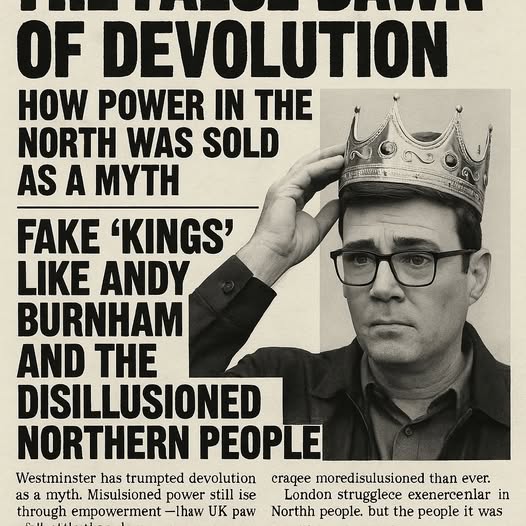
The False Dawn of Devolution: How Power in the North Was Sold as a Myth
For years, Westminster has trumpeted devolution as the democratic panacea for the regions of England. The promise was simple: give the North more say in its future, empower its leaders, and re-balance the economy away from London. But in reality, devolution has not delivered empowerment — it has entrenched disillusion.
At the centre of this narrative stand so-called regional “kings” — political figures like Andy Burnham, whose carefully cultivated image as the voice of the North masks the deeper truth: meaningful power still resides in London. Devolution in its current form has created celebrity mayors with inflated titles but limited tools. They have become lightning rods for local frustrations without ever being given the authority to change the fundamentals.
The London Grip Tightens
Despite the rhetoric, Whitehall still controls the purse strings. Local authorities and combined mayoralties remain dependent on grants, hand-outs, and approval from central government. Billions flow south, while northern transport, housing, and health systems are starved of coherent investment. The so-called “levelling up” agenda is a photo-op, not a plan.
The North is sold the illusion of autonomy, while London strengthens its grip. Every key policy lever — taxation, welfare, immigration, industrial strategy — remains firmly locked in the capital. The mayors, meanwhile, are left to manage piecemeal budgets and announce shiny but shallow initiatives that do little to alter structural decline.
The Rise of the “Fake Kings”
Burnham in Manchester, Rotheram in Liverpool, Houchen in Tees Valley: they have become household names, but their authority is more symbolic than real. They posture as defenders of the North, but too often function as political PR machines. They claim victories for scraps handed down by Westminster while failing to admit how little actual power they hold.
The spectacle has fooled few. In working-class communities across Greater Manchester, Merseyside, and beyond, voters see through the act. Devolution has not transformed daily lives. Jobs remain insecure, public services strained, and infrastructure broken. The North still lags behind on productivity, wages, and opportunity. The mayors have cultivated celebrity status — but they cannot conceal the broken system they preside over.
Disillusion Rising
The result is widespread cynicism. Once, devolution was sold as the answer to the “London problem.” Now, many in the North see it as another layer of bureaucracy and false promises. Town halls feel sidelined. Local councils struggle. Communities feel abandoned. The grand “Northern Powerhouse” vision has collapsed into a collection of photo opportunities and hollow soundbites.
In truth, the UK remains one of the most centralised states in Europe. London’s political, financial, and cultural dominance is greater than ever. Devolution has not shifted the balance — it has obscured it.
The Verdict
Britain’s northern territories deserved better. They deserved real investment, real authority, and real respect. Instead, they got figureheads — “fake kings” — with limited powers and limitless ambition.
As long as London passes the keys without checks and balances, devolution in the North will remain a façade: a promise of power that rarely materialises well, leaving the people it was meant to serve more disillusioned than ever.