
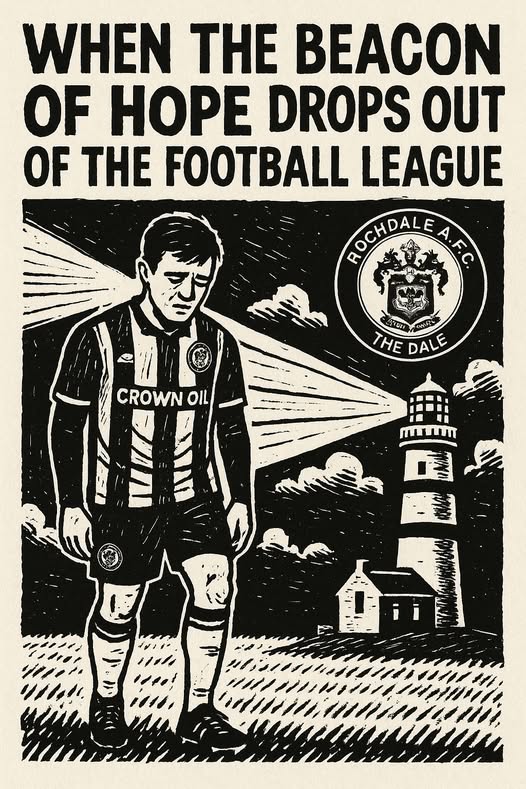
When the beacon of hope drops out of the Football League
Rochdale AFC since 1995: the climb, the cup nights, the kids—and the cost of falling
For nearly all of the past three decades, Rochdale AFC’s story has been one of stubborn endurance, punctured by exhilarating spikes of progress and youth development that outpunched the club’s budget. Then, in April 2023, the 102-year Football League stint ended with relegation—an institutional shock for club and town alike.
The modern peaks: 2009–2017
Keith Hill’s two spells defined Rochdale’s best modern years. After near-miss play-offs in 2008 and 2009, automatic promotion arrived in 2009–10; a second promotion followed in 2013–14. Back in League One, Rochdale posted their highest modern finish—8th place in 2014–15—and repeated top-half campaigns on one of the division’s leanest budgets.
There were grand cup nights, too: the 2018 FA Cup draw with Tottenham at Spotland that forced a Wembley replay, and the 2019 EFL Cup tie at Old Trafford where Dale held Manchester United 1–1 before losing on penalties—performances that showcased coaching clarity, togetherness and a thriving pathway.
The pathway: a small club’s big edge
Rochdale’s competitive edge was often its academy and development culture. The club blooded and sold young talent—Luke Matheson (a debut at 15, a goal at Old Trafford at 16, then a move to Wolves), Dan Adshead (sold to Norwich City), Callum Camps and Andy Cannon among others—while consistently promoting its own midfield schemers and leaders.
Three emblematic names
Grant Holt – Rebooted his EFL career at Rochdale (42 goals in 83 games) before climbing to Nottingham Forest and becoming a Norwich City talisman. His Dale stint remains a textbook example of value creation by smart recruitment.
Nathaniel Mendez-Laing – Re-energised under Hill, hit double figures for goals and assists in 2016–17, then stepped up to Cardiff City and helped win promotion to the Premier League the following season.
Jamie Allen – A Rochdale lifer from age eight who captained the first team as a homegrown midfielder before carving out a Championship career with Coventry City. He is the archetype of the Dale pathway delivering both identity and transfer value.
And hovering over it all: Ian Henderson, the model senior pro and mentor figure, now the club’s all-time leading scorer—longevity and standards personified.
The fall and its aftershocks
The EFL exit in April 2023 was more than a relegation; it was a reclassification. Outside the EFL, the Premier League’s Elite Player Performance Plan (EPPP) no longer automatically covers a club’s academy. Rochdale publicly explained that, under EPPP rules, clubs relegated from the EFL can continue to run an academy for a maximum of two years—a grace window that makes long-term planning and staff retention intensely difficult.
Financially, the cliff is steep. Clubs lose EFL central distributions and solidarity money; the gap to National League funding and commercial reach is material. Even in a best-run scenario, the squeeze on cashflows hits first-team competitiveness and youth provision at the very points a fallen club needs them most.
By February 2024, Rochdale’s board warned that without a £2m injection the club risked liquidation—an existential alarm that underlined how fragile the post-EFL terrain can be. New investment ultimately arrived, but the message was stark: momentum is expensive to rebuild.
Parallels and cautionary tales
Bury FC: Expelled from the EFL in August 2019 after chronic financial failings, Bury became a national case study in what happens when a town’s footballing anchor collapses. The club’s return to Gigg Lane under a merged, fan-backed structure came only in 2023, after years of civic loss—and it took public funding and tireless community work to relight the ground.
Oldham Athletic: Relegated from the EFL in 2022 amid protests and ownership turbulence, Oldham returned in June 2025 via a breathless 3–2 extra-time play-off win at Wembley—a reminder that recovery is possible, but never guaranteed.
Carlisle United: Promoted in 2023, they then suffered back-to-back drops and were relegated to the National League in April 2025—proof that even historically well-supported community clubs can skid quickly in a volatile financial-sporting ecosystem.
Why clubs like Rochdale are “beacons of hope”
In post-industrial, working-class towns, professional clubs operate as civic institutions: convening identity, routine and pride; distributing health, education and inclusion programmes; and anchoring local volunteering and youth engagement. The EFL’s own community impact work estimates £400m-plus of annual social value and tens of thousands of local jobs supported across its clubs and charities—figures that understate the intangible glue of belonging a Saturday at Spotland creates.
Public policy has started to catch up with this reality. The UK government’s 2023 football governance white paper framed clubs as community assets, criticised poor stewardship, and argued for stronger protections after cases like Bury—implicitly recognising that when a club falls, the damage radiates well beyond the pitch.
At a micro level, academies are a town’s talent escalator: a place where a ten-year-old can dream in club colours and, sometimes, become the next Jamie Allen. When EFL status goes, that escalator judders; scouting radiuses, games programmes and funding all shift. The risk is a generation that sees the pathway narrow just when the town most needs reasons to believe.
Responsibility to people and place
Rochdale’s best years since 1995 were built on coherent coaching, a worker-bee pathway, smart recruitment and a club-wide humility that matched the town’s ethic. The obligation now—shared by owners, local institutions and supporters—is to re-forge that model in tougher conditions: protect the academy while it can be protected; maintain a first-team identity that trusts young players; and keep community programmes visible and accessible, even when budgets bite.
Because in towns like Rochdale, a professional club isn’t just weekend theatre. It’s a civic heartbeat. When that heartbeat falters—when a beacon of hope drops out of the Football League—the whole community feels the cold. The work of warming it back up is long, unglamorous and vital. And if the stories of Bury’s return, Oldham’s revival, and Carlisle’s determination teach us anything, it’s this: a club can fall, but a community’s will to rebuild can be stronger still.
Key sources: club and league records, government policy notes, and reporting on Bury, Oldham and Carlisle provide the factual backbone for this piece.