
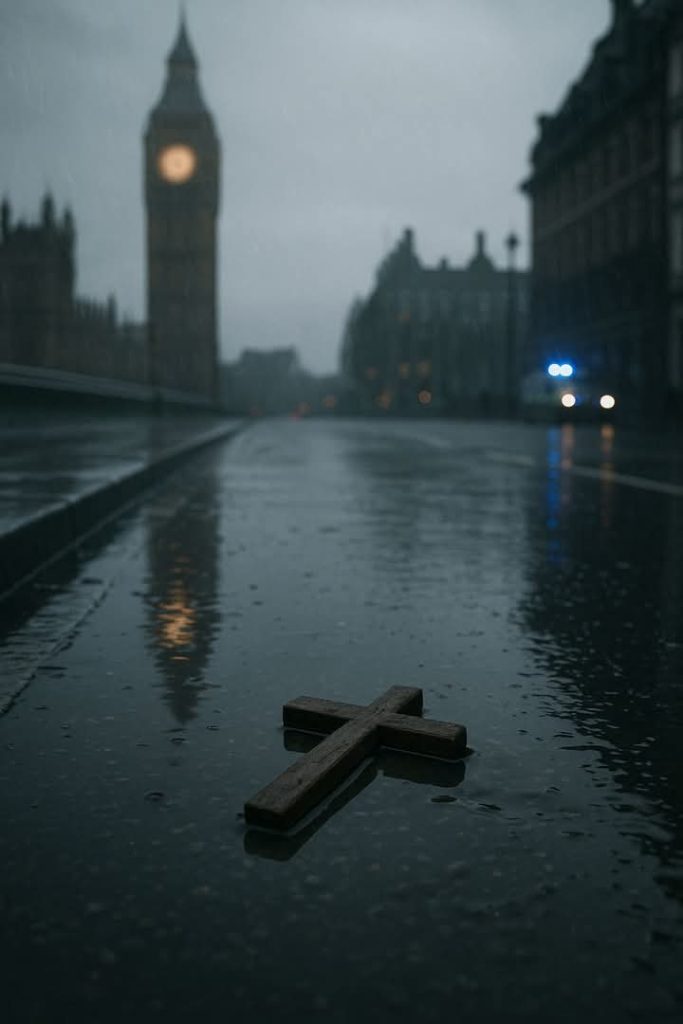
“Blind Spots & Double Standards?” — Anti-Christianity and the Two-Tier Policing Debate in the United Kingdom
By Jonty Hall
Britain claims to pride itself on a projection of even-handed justice and equal protection for all creeds. Yet ask many everyday churchgoers, chaplains, street preachers, or people supportive of Christianity and you’ll hear a different story: a creeping suspicion that Christianity is fair game for ridicule, sanction, or summary removal — while other identities appear to enjoy stronger, swifter protection. That perception of “two-tier policing” has become a political football. What does the record actually show?
What the numbers say — and don’t say
The government’s own data show religious hate crime rose sharply last year, driven mainly by surges in antisemitic and anti-Muslim offences after the Israel-Hamas war. Within that spike, police recorded 702 anti-Christian offences in 2023/24 — around 7% of all religious hate crimes. In the same year there were 3,282 anti-Jewish and 3,866 anti-Muslim offences. These figures show Christians are not immune from targeted hostility, even if they are not currently the most attacked group.
Case law that still matters
Anti-Christian claims are not just about feelings; some have prevailed in court. In Eweida and Others v United Kingdom (2013) the European Court of Human Rights held that UK authorities failed to protect a Christian employee’s Article 9 right to manifest her faith when British Airways prevented her from wearing a small cross — awarding damages and costs. The principle was simple but important: employers and the state must strike a fair balance when religious expression is at stake.
On the street, several high-profile arrests of Christian preachers have ended with apologies or payouts. In 2019, the Met paid Oluwole Ilesanmi £2,500 for wrongful arrest. In 2024, Hatun Tash received £10,000 after a court found she’d been unlawfully arrested and detained. These outcomes don’t prove systematic anti-Christian bias — but they do reinforce concerns that officers sometimes reach too quickly for cuffs when the speaker is a Christian evangelist.
“Two-tier policing”: accusation vs. evidence
Former home secretary Suella Braverman accused forces — especially the Met — of “double standards,” claiming leniency toward some protest movements while throwing the book at others. The charge became a staple of online discourse. When Parliament’s Home Affairs Select Committee reviewed the tumultuous disorder of summer 2024, it concluded there was “no evidence of two-tier policing” in the police response. Likewise, the National Police Chiefs’ Council welcomed those findings, and an HMICFRS inspection in 2024 examined activism and impartiality in policing to tighten standards. The debate is fierce; the official evidence so far is mixed for the two-tiers claim. A different problem the Met does admit
Grooming-gang scandals and the fear of saying the obvious
The most damaging blows to trust came from catastrophic failures around organised child sexual abuse in Rotherham and Greater Manchester. Independent inquiries described years of denial and inaction by councils and police, including a reluctance to name offending patterns involving groups of men of Pakistani heritage. Critics called this a fatal over-correction — a culture so anxious about accusations of racism that it abandoned vulnerable British children. These scandals fuel a public belief that policing bends one way to avoid controversy. We must be precise here: they concern South Asian (not merely “South-East Asian”) perpetrators in certain locations and time periods — and they indict leadership failure, not any ethnicity as a whole.
So, are Christians treated worse?
Christians can and do win important freedom-of-religion cases (Eweida). Christians have been wrongly arrested for preaching and later vindicated (Ilesanmi, Tash). Anti-Christian hate crime exists (at least hundreds of offences annually), but it is lower than the surges seen against Jewish and Muslim communities. The two-tier accusation, when tested against recent national reviews of protest policing, has not yet been substantiated in the eyes of the Nation’s leadership. Yet trust has been eroded by widely publicised misjudgments, high-profile arrests of Christians, and the state’s well-documented institutional failings.
Where do we go from here?
1. One standard, rigorously applied. Police must be trained — and seen — to protect free expression for Christians as robustly as for any other group, intervening on behaviour (harassment, violence, credible threats), not on viewpoint.
2. Transparent protest policing. Publish clear, comparable thresholds for arrests, conditions, and bans across events. The parliamentary review after 2024’s disorder sets out an evidence-base; Police leaders should commit to regular side-by-side reporting to counter the “two-tier” narrative where it isn’t borne out — and expose it where it is.
3. Culture change, not slogans. Implement the Casey recommendations with urgency: better vetting, discipline, data, and leadership. Without cultural reform, every misstep will be read as bias — especially by communities already wary, including many Christians.
4. Equal seriousness for all hate crime. The same urgency mobilised against antisemitism and so-called Islamophobia must also meet anti-Christian incidents — while acknowledging the very real spikes against Jewish and Muslim neighbours. That is the civic compact.
Final word
The point isn’t to turn communities against each other in a competition of grievances. It’s to demand a professional, impartial service that protects the right to preach the gospel in the high street, to wear a cross at work, to march or protest in safety — and to shield children, whoever they are, from predators. If policing can’t hold that moral line, Britain’s promise of equal protection before the law becomes just another slogan.
**************************************************Selected sources & further reading
Home Office, Hate crime, England and Wales, year ending March 2024 (tables on targeted religions).
ECtHR, Eweida and Others v United Kingdom (2013) — Article 9 violation over cross-wearing at work.
Metropolitan Police, Baroness Casey Review (2023) — finding of institutional racism, misogyny, homophobia.
Home Affairs Select Committee, Summer 2024 disorder — “no evidence of two-tier policing” in the response.
Metropolitan Police payouts to Christian preachers: Ilesanmi (2019); Tash (2024).
Professor Alexis Jay & subsequent reporting on Rotherham (failures and ethnic-pattern sensitivity).
*The Dale Blues – The Non-Propaganda Global Voice from Broken Britannia.*