
ANTIFA UK: A Globally Connected Threat to Stability
By Jonathon Hall & The Dale Blues Political Correspondents
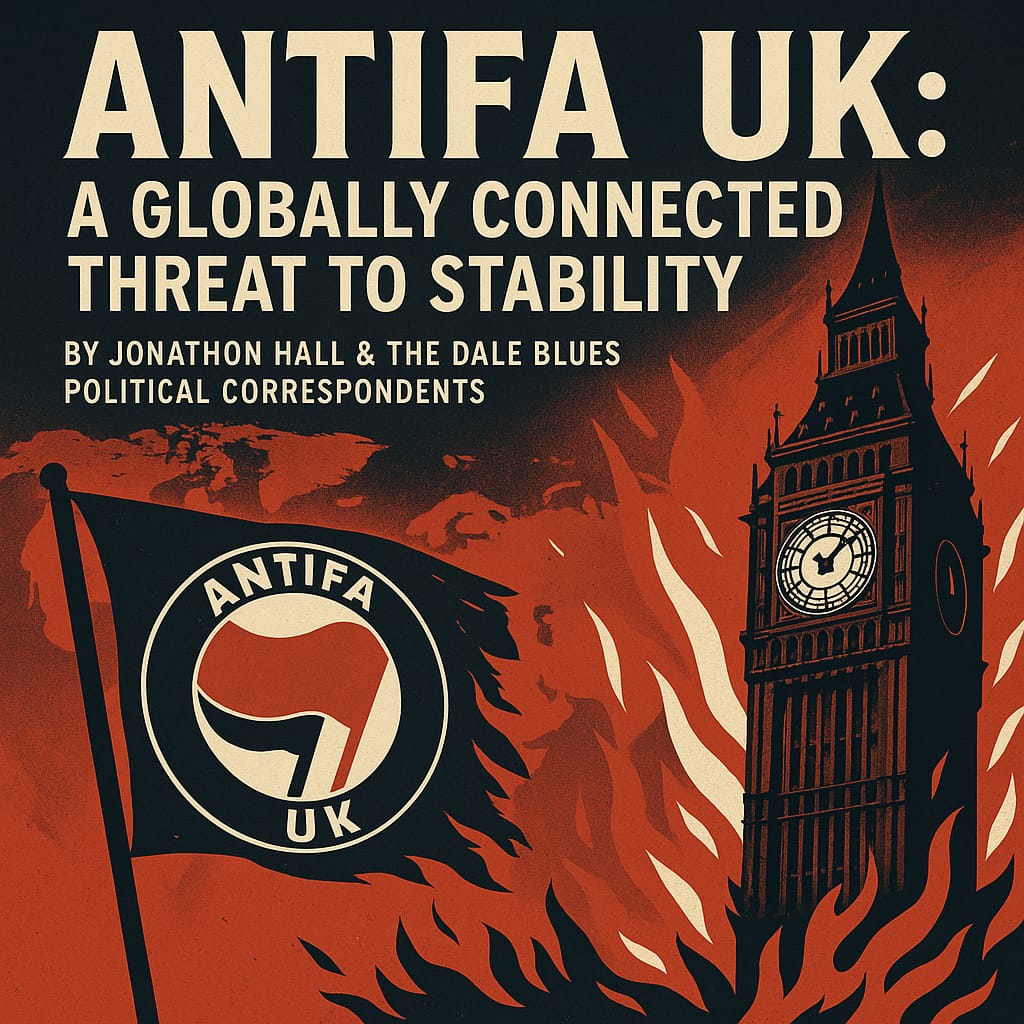
For years, Britain has been quietly observing the steady rise of a hard-to-define but highly coordinated network of ultra-radical activists operating under the loose banner that commentators have come to call Antifa UK. Though lacking the formal structures and identifiable leadership found in traditional extremist organisations, this movement has nevertheless grown into an internationalised network whose operational style mirrors that of more familiar global extremist currents.
At the heart of the concern is not simply the disruptive street-level behaviour occasionally splashed across social media, but the ideological triad underpinning the movement: a strain of aggressive neo-communist thinking, a willingness to exploit the chaos generated by violent extremist factions around the world, and a naïve but increasingly influential woke orthodoxy that dismisses the foundations of Britain’s cultural identity as relics to be dismantled.
A Network Without Borders
What makes this movement especially potent is its international connectivity. Digital channels, encrypted forums, and cross-continental activist communities have built bridges that allow tactics, rhetoric, and operational methods to bounce rapidly from one nation to the next. In this sense, Antifa-type activism is not simply a British challenge; it is part of a much wider, synchronised model adopted by ultra-left blocs worldwide.
British authorities — both official and unofficial — are acutely aware that this ideological pipeline is being used to import strategies designed to destabilise democratic societies. The UK’s own version has adopted these approaches with alarming proficiency.
The Ideological Fusion Driving the Threat
The danger lies not in one ideology alone, but in a fusion of mutually reinforcing extremes:
Neo-Communist agitation, pushing for the delegitimisation of British institutions and the erosion of private enterprise
Radicalism that intersects uncomfortably with global extremist movements, which thrive on social division and weakened national resolve
Woke cultural dogma, naive in presentation but corrosive in effect, painting the very values that hold this country together as oppressive systems to be dismantled
This cocktail produces a movement capable of energising anger, coordinating disruption, and mobilising young, disaffected individuals who may not understand the full implications of the ideologies they are absorbing.
Impact on British Society
The consequences of this movement’s rise are visible:
Intimidation of political opponents, both online and in physical spaces
Cultural antagonism, where dissent from hard-left orthodoxy is met with public shaming or economic pressure
Organised disruption, targeting civic life, community events, and democratic processes
Erosion of national confidence, as British identity is cast as a historical burden rather than a source of shared pride
Britain has long prided itself on tolerance, free expression, and democratic resilience. Yet these virtues are increasingly exploited by groups intent on undermining them.
A Challenge for the Kingdom’s Future
This is the uncomfortable truth: movements that operate without hierarchy can be the hardest to counter. Their agility, decentralisation, and ideological fervour create a threat that is cultural as much as political — a threat not only to public order but to the very values that generations have fought to protect.
Traditional British life — grounded in community, continuity, decency, and stability — is being confronted by a highly internationalised radical movement that seeks nothing less than its fundamental reimagining.
Where Britain Goes From Here
The task ahead is to reassert the principles that have long defined the United Kingdom:
Respect for the rule of law
Pride in national heritage
Protection of open debate without intimidation
Defence of civic order against those who would dissolve it
Antifa-styled extremism thrives in the grey areas between protest and coercion, between activism and destabilisation. Recognising this threat for what it is — an increasingly global ideological network — is not alarmism. It is realism.
Britain need not fear the future. But it must neither ignore nor underestimate movements that reject the foundations of the society we share.