
THE DALE BLUES – SPECIAL FEATURE
By Bruckshaw-Iovaine
BOYS’ & MEN’S HEALTH: THE FOUNDATION OF SOCIETY, COMMUNITY INTEGRITY & NATIONAL PEACE
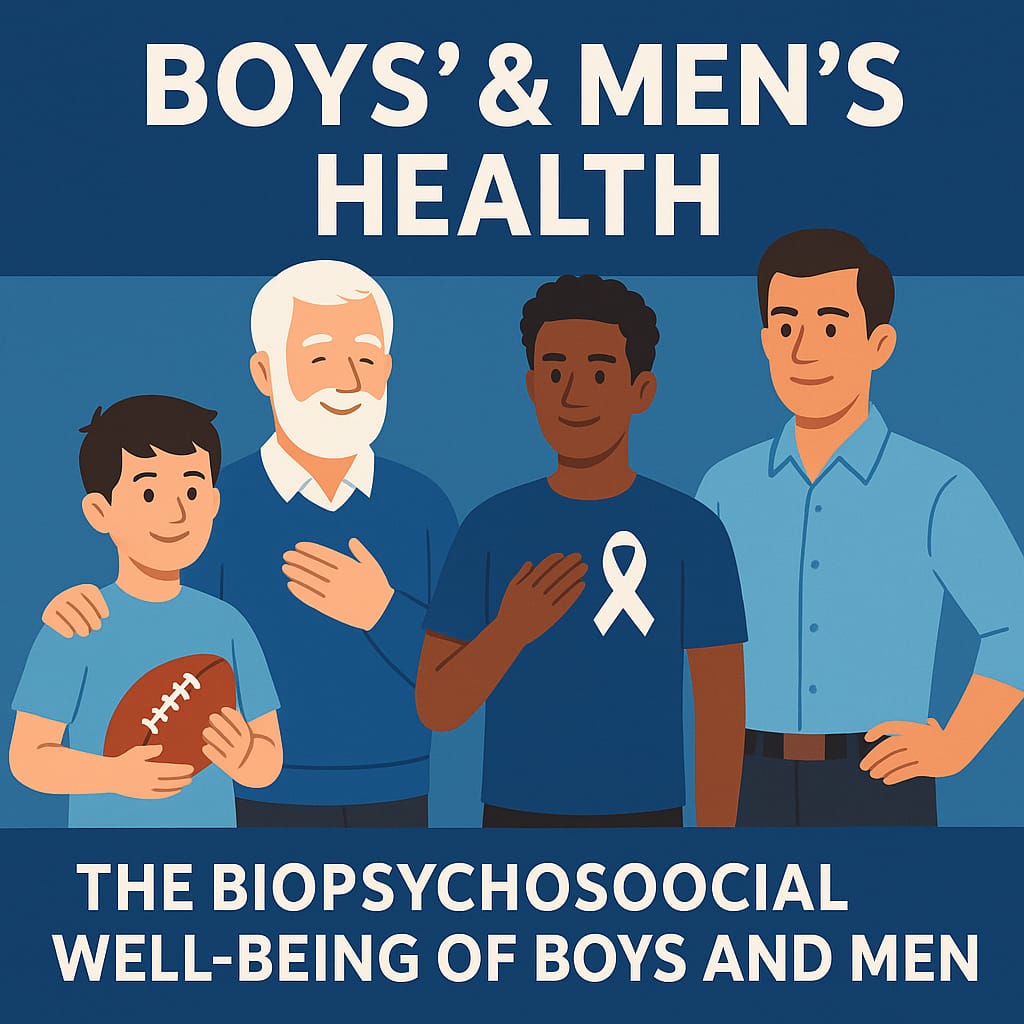
For decades we have tip-toed around the truth: boys’ and men’s health underpins society, community integrity, and national peace via strength. Not strength in the old sense of silent suffering or clenched-jaw stoicism, but strength in the biopsychosocio sense — the healthy unity of the biological, psychological, and sociological dimensions of a male’s life.
We cannot build stable communities or a peaceful nation without investing in the wellbeing of the boys and men who form so much of its backbone. The evidence is all around us: rising male suicide rates, boys disengaging from school, men withdrawing from community life, overstretched CAMHS services unable to keep pace with demand, and cultural expectations that remain, frankly, confused.
And yet, the solution is not complex; it is courageous. It means truly seeing boys and men again.
BIO – THE BIOLOGICAL REALITIES
Boys and men develop differently. Their hormonal patterns, growth trajectories, and neurological profiles bring both strengths and vulnerabilities. They are often expected to be physically capable, energetic, competitive, composed — even when their bodies are going through intense change or their sleep and nutritional needs are neglected.
Physical health is not a luxury. It’s a prerequisite for:
Concentration
Impulse control
Emotional regulation
Social bonding
Resilience
From school PE to local football clubs to national men’s health policy, the biological must be recognised as the common foundation for healthy male development.
PSYCHO – EMOTIONAL & COGNITIVE GROWTH
For boys especially, emotional growth has often been limited by outdated cultural ideas: don’t cry, man up, be tough, don’t show weakness. But the truth is simple — a boy who cannot safely express emotion becomes a man who struggles to connect, communicate, and cope.
We need:
Early emotional literacy in schools
Mentors who model healthy masculinity
Fathers, uncles, coaches, and male teachers who talk, listen, and guide
Proper access to CAMHS and early-intervention services
A national culture shift recognising that strength and vulnerability are not opposites — they are companions
A psychologically strong boy becomes a psychologically strong man, one who:
Leads without dominating
Loves without fear
Works with purpose
Responds to challenge, not collapses under it
SOCIO – THE SOCIAL ROLE OF MEN & BOYS
Boys and men are expected to provide, protect, influence, produce, hold their emotions steady, contribute to the economy, support families, and remain brave during adversity. But without the right social structures — community clubs, trusted male role models, positive peer groups, safe outlets for stress, and stable institutions — these expectations become unbearable weights.
The sociological pressures today are enormous:
Social media images of impossible perfection
Cancel culture suppressing honest male expression
Community fragmentation
Lack of intergenerational connection
Rising cost-of-living stress on fathers and families
Boys punished more but understood less in schools
If society wants stable families, secure neighbourhoods, productive workplaces, and peaceful streets, we must invest in the social scaffolding around boys and men.
Because when men thrive, communities stabilise. When boys feel connected, schools calm. When fathers are supported, households flourish. And when young men are guided, whole towns regenerate.
THE HEART OF IT ALL: HEALTHY EMOTIONAL GROWTH
It begins young.
A boy who is allowed to:
express emotion,
speak freely,
be guided by principled men,
experience healthy boundaries,
develop self-control through sport and positive challenge,
succeed, fail, try again,
…is a boy who becomes a man with integrity, purpose, and inner peace.
The “future man” already lives in the 5-year-old learning how to manage frustration on a football pitch, the 10-year-old negotiating friendships, the 14-year-old wrestling with identity, and the 17-year-old deciding what kind of adult he wants to become.
CAMHS, SUPPORT SYSTEMS & WHAT MUST CHANGE
CAMHS is flooded. Boys in particular are slipping through the cracks because their distress is often externalised — behavioural, disruptive, withdrawn, or masked by humour. They need:
Faster access
More male practitioners
Trauma-informed approaches
Community-based preventative programmes
Stronger school-sport partnerships
CAMHS should not be the last resort — it should be integrated into a national system of early care built around mentorship, sport, family engagement, and community-led support.
THE NATIONAL TRUTH
Nations fall when boys fall.
Nations rise when men rise.
And nations find peace through the balanced strength of their males — not through aggression, but through grounded, stable, emotionally mature men who contribute to society with dignity and purpose.
Boys’ and men’s health doesn’t sit alongside national stability — it creates it.
CONCLUSION: A CALL TO LEADERS
If we want:
stronger families,
safer communities,
more resilient boys,
calmer schools,
lower crime,
and long-term national peace,
…then the investment must begin where stability begins: the biopsychosocio wellbeing of boys and men.
It is time to put boys and men back at the centre of the national conversation — not in dominance, but in dignity.
Because boys’ and men’s health is not a side issue.
It is the quiet engine of civilisation.
And if we strengthen that engine, the whole nation moves forward.
— Bruckshaw-Iovaine, The Dale Blues