
THE DALE BLUES – ANALYSIS & COMMENTARY
By Mark Bradley Shaw
CONTEMPORARY IRELAND: A NATION STILL SHAPING ITS FUTURE
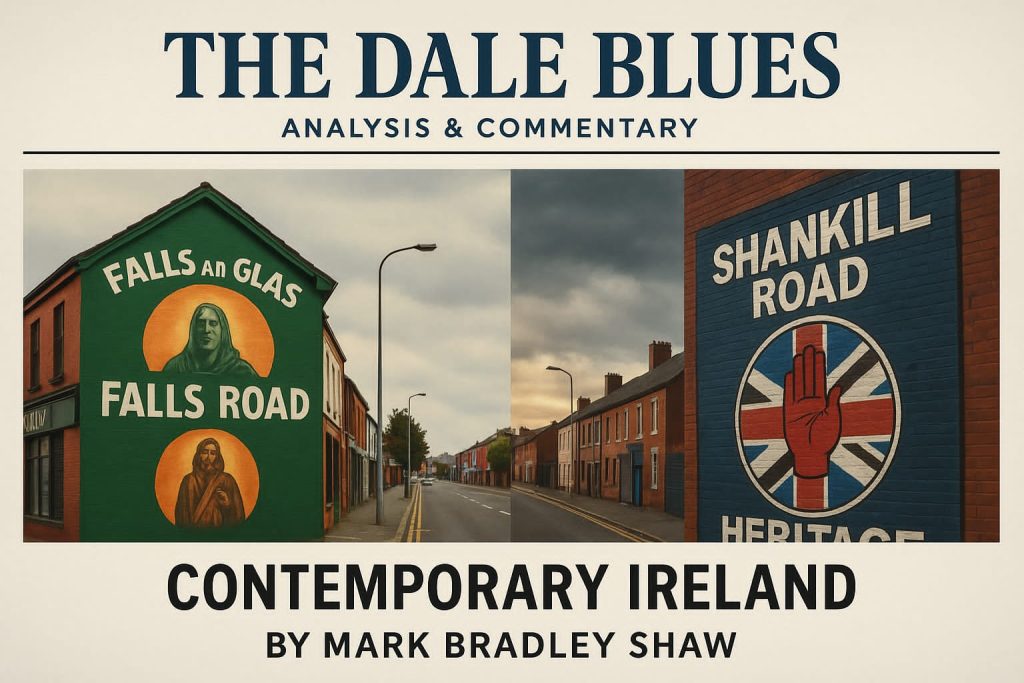
Ireland—both North and South—remains one of the most fascinating political and cultural landscapes in the Western world. A place of remarkable global reach, rich contradictions, and continually shifting identities, it stands today at a crossroads where history and modernity collide with uncommon force.
Sinn Féin and the Shape of Political Change
No discussion of contemporary Ireland can overlook the rise—and in many ways, the redefinition—of Sinn Féin. Once viewed narrowly through the prism of conflict-era politics, the party has repositioned itself as a mainstream social and economic force across the entire island. In the Republic, it now represents a generation demanding housing reform, cost-of-living solutions, and a more assertive national posture in global affairs.
In Northern Ireland, Sinn Féin’s electoral success and the appointment of its first nationalist First Minister sent symbolic shockwaves through long-established political structures. It does not automatically herald constitutional change, but it undeniably shifts the gravitational centre of power.
The Loyalist Community: A Tradition Under Strain
Across the divide, the loyalist community of Northern Ireland finds itself in a moment of deep internal questioning. Longstanding cultural identity—Britishness, monarchy, unionism—remains firm. But the context around those values has changed dramatically.
Brexit exposed fractures and insecurities within loyalism. Many feel promises were made but not kept; that the Union was rhetorically defended but practically weakened. For communities built on duty, loyalty, and heritage, the sense of being politically orphaned grows more palpable. These frustrations don’t diminish the community’s dignity or resilience, but they do underscore a need for new leadership and a refreshed conversation about what the future Union looks like.
Brexit and the Irish Question: A Puzzle Still Unsolved
Delivering Brexit was always going to be challenging—but nowhere more so than on the island of Ireland, a place where borders are not simply lines on maps but veins running through identity, family, and memory.
The Northern Ireland Protocol, and later the Windsor Framework, attempted to square a circle that perhaps cannot be perfectly squared. The UK sought regulatory freedom; Ireland and the European Union sought the protection of the all-island economy and the peace architecture. What emerged was a hybrid arrangement pleasing no one entirely but preventing the worst outcomes.
Contemporary Ireland, North and South, is living with the consequences of this compromise. It remains an ongoing project—fragile, complex, and far from final.
The European Union and the Irish Position
For the Republic of Ireland, the European Union has become not merely an alliance but a cornerstone of national strategy. EU membership expanded Ireland’s economy, modernised its policies, and placed it firmly in the global centre of trade, technology, and diplomacy.
In a world of geopolitical volatility, Ireland uses the EU as both shield and amplifier. It is small in size but large in influence—proof that connectivity, not geography, determines power.
Northern Ireland, meanwhile, occupies a unique space: part of the UK, yet intertwined economically with the EU. This duality brings tension, but also opportunity—if leaders can navigate it wisely.
A Global Irish People
Perhaps the most defining feature of contemporary Ireland is not found on the island at all. It lies in the cities, fields, and communities across the world where millions of Irish diaspora live and contribute.
From Boston to Buenos Aires, Sydney to San Francisco, Toronto to London, the Irish have built a global network unmatched by most nations of comparable size. This diaspora retains a cultural thread stretching back to the island—music, memory, struggle, humour, and grit.
In an era of globalisation, the Irish identity has become one of the world’s most powerful soft-power commodities: warm, resilient, clever, and confident.
Conclusion: Ireland Still Becoming
Contemporary Ireland is neither the Ireland of old nor the Ireland of a distant political dream. It is a dynamic, evolving nation—divided yet connected, proud yet searching, rooted yet global.
Sinn Féin’s rise, the loyalist community’s concerns, the unending Brexit recalibrations, and the anchoring role of the European Union are all part of a singular truth:
Ireland is still becoming.
And in that becoming, the world continues to watch—because the Irish story, in all its complexity, has never belonged solely to the island. It has always been, and remains, a story for the world.