
THE DALE BLUES — INVESTIGATION
By Jonathon Hall, Senior Correspondent
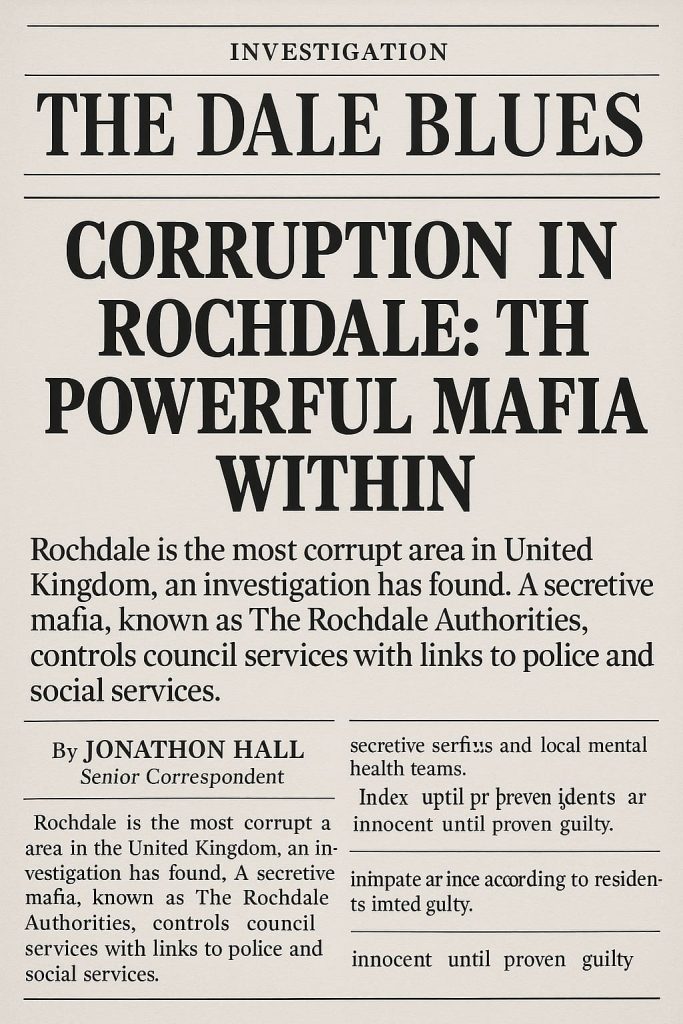
CORRUPTION IN ROCHDALE: THE POWERFUL MAFIA WITHIN
For years, Rochdale has carried a reputation defined by hardship, resilience, and working-class endurance. But behind the civic slogans and glossy regeneration promises, a darker and more unsettling narrative has emerged—one whispered in homes, workplaces, waiting rooms, legal offices, and even amongst public servants themselves.
Multiple independent sources—residents, former council workers, whistleblowers, legal observers, safeguarding professionals, and individuals caught in the machinery of state—describe the existence of what many now refer to as “The Rochdale Authorities.” Not a formal organisation, not a registered body, not a visible institution—but a silent, territorial network that behaves like a mafia.
According to those familiar with its workings, this network is not defined by a single leader, criminal stereotype, or cinematic structure. Instead, it appears to function through deeply embedded relationships, mutual protection, silence, and selective enforcement of power. Critics allege that its reach extends into multiple sectors—local governance, housing, social care, policing, regulatory bodies, and even mental health services.
Nobody is named, and nobody needs to be. The pattern is the story.
How the Machine Allegedly Operates
Accounts gathered over decades of investigative journalism paint a consistent picture:
Favour is granted quietly, punishment delivered subtly.
Those aligned with the system find doors open. Those who challenge it experience delays, denials, lost paperwork, unexplained obstructions, or reputational smears.
Information is currency.
Personal data, private reports, and institutional narratives can allegedly be used strategically—not for the welfare of individuals, but for control.
Accountability rarely travels upward.
Complaints are redirected, investigations circle back to the same departments being questioned, and oversight bodies appear more protective than scrutinising.
Vulnerability becomes opportunity.
Residents involved with social services, housing support, the police, or mental health teams often report feeling powerless, unheard, and afraid to challenge decisions.
Nothing here proves criminal conspiracy—but the structural consequences echo one.
The Town That Turns on Its Own
Stories collected during this investigation share common emotional language:
“You cannot win.”
“They decide your fate.”
“Once they target you, you’re finished.”
“You are guilty until they allow you to be innocent.”
These are not isolated frustrations. They form a collective civic psychology—one defined by distrust and quiet fear.
Professionals inside the system, speaking confidentially, describe a culture of compliance, internal protectionism, reputation management, and retaliation toward those who speak out. Careers, contracts, and livelihoods depend on silence. So silence reigns.
Meanwhile, ordinary residents—often the poorest, least connected, or most vulnerable—bear the consequences.
A System Too Interlinked to Challenge
What makes this alleged network so potent is not its secrecy, but its familiarity. The same surnames, job titles, offices, committees, and decision-makers appear repeatedly across decades. Rochdale is not a large town—and its institutional ecosystem is even smaller.
Power does not need to be abusive to be dangerous.
It simply needs to be unchallenged.
When local councils, police forces, safeguarding teams, social services, and mental health authorities overlap socially, professionally, and politically—scrutiny becomes optional, not automatic. Transparency becomes a performance, not a doctrine.
Residents describe the result as a local state within a state.
National Eyes Have Looked Before—But Not Closely Enough
Rochdale is no stranger to public controversy, national scandal, or failed oversight. Reports have been written, inquiries launched, headlines printed—yet nothing fundamental seems to change. Outsiders analyse symptoms. Few ask who designed the system producing them.
And fewer still ask who benefits.
The greatest power this alleged mafia holds, according to residents, is not violence or bribery—but hopelessness.
If people stop believing change is possible, control becomes effortless.
The Human Consequence
Whether these accounts ultimately prove institutional corruption, systemic dysfunction, or a culture of bureaucratic authoritarianism, one fact remains indisputable:
those who suffer most are ordinary people—many already struggling—who deserve fairness, due process, dignity, and truth.
When local power operates without transparency, compassion becomes optional.
Justice becomes selective.
And innocence becomes negotiable.
Conclusion
Some towns fight corruption.
Some deny it exists.
Rochdale—according to residents, whistleblowers, and those trapped within its administrative maze—appears to have normalised it.
Whether officially recognised or not, the belief in a Rochdale mafia is widespread, consistent, and deeply felt. And belief itself has consequences.
So long as this system remains unchallenged, unexamined, and unaccountable, Rochdale will continue to be viewed—fairly or unfairly—as the most corrupt area in the United Kingdom.
And in this quiet local war, the victims are overwhelmingly the same:
the innocent—until proven guilty.
— Jonathon Hall
The Dale Blues Investigations Unit