
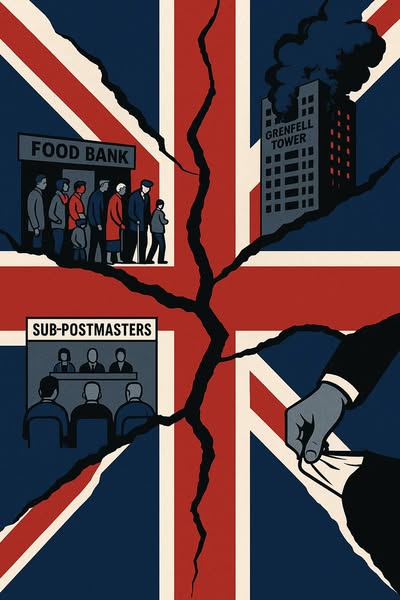
“A light for those left in the shadow”
The State Betrayed: How Britain Betrays Its Own
There is a rot at the heart of the British state. Over successive administrations — Conservative, Labour, and coalition alike — the United Kingdom’s government has, time and again, acted not as a guardian of the weak, but as an oppressor of its own people. It has turned bureaucratic machinery, policing powers, and regulatory neglect into instruments of destruction — particularly against those who, through hard work and decency, have sought only dignity and fairness.
Poverty and despair amid plenty
Consider for a moment the statistics: even before the COVID crisis, many working families faced hunger, insecure housing, and benefits sanctions. The Joseph Rowntree Foundation and other independent watchdogs have repeatedly documented that “in-work poverty” is not a by-product but a feature of modern Britain. Whole communities have been hollowed out: high streets closed, transport links decaying, public services starved. People are forced to choose whether to heat or eat, whether to see a dentist or pay the rent.
And when the state errs — as with the Post Office Horizon scandal — it drags its feet, offers apologies years too late, and refuses to compensate victims fairly. Over 900 sub-postmasters were wrongly prosecuted, lives ruined, trust destroyed — and only after sustained pressure did the government open a public inquiry and begin talking about redress. (The gravity of that betrayal still echoes.)
These are not isolated injustices. They form part of a pattern: if you sit outside the corridors of power, you are expendable.
“Let the bodies pile high” — the ethos of callous governance
No phrase better captures the moral bankruptcy of statehood in Britain than the alleged remark attributed to Boris Johnson: “let the bodies pile high in their thousands”. According to Dominic Cummings, Johnson uttered that phrase (or something close to it) in October 2020, when resisting imposition of a lockdown. Multiple witnesses have come forward, some prepared to swear under oath that they heard it. Johnson has denied the claim, calling it “absurd” and “total rubbish.” Yet, even if one grants him the benefit of doubt over his phrasing, the core truth remains: lives were sacrificed in the name of political convenience, delay, and indecision.
Let us be clear: the sources of the COVID-19 virus, the origins in Wuhan or any supposed “lab leak,” the theories about chemical warfare or mass population control — these are contested and deeply complex matters. There is no credible, accepted evidence in mainstream scientific, intelligence or epidemiological consensus that China manufactured SARS-CoV-2 in 2019 as a weapon. That said: whether by malice, incompetence, or hubris, the British state’s own response was brutal. It behaved as though many human lives were collateral damage. When the government treats death as a statistic, it reveals its ultimate loyalties: not to citizens, but to optics, markets, and power.
Persecuted for speaking truth
Local authorities collude with police, “counterterrorism” labels are casually deployed to intimidate, and complaint systems are rigged to protect insiders rather than redress harm. Those who have dared speak — journalists, whistleblowers, community leaders — have found themselves increasingly isolated, marginalized, or worse.
This is the ugly underside of the myth of “equality under British law.” For many, equality is a lie. Your postcode, your accent, your ethnicity, or your political stance can mark you for suspicion. Police forces exist in tiers: some precincts enjoy deference, others are policed harshly; some communities are watched and choked, others protected. Corruption in the police is not anecdotal. A government-commissioned report on corruption in the police services of England and Wales revealed that a majority of cases involved perversion of the course of justice or theft/fraud, and that many cases were handled internally rather than referred to independent bodies.
The Independent Office for Police Conduct, too, is under scrutiny for failures to hold officers truly to account. And in its State of Policing 2023 annual assessment, inspectors noted continuing problems in forces’ recognition and investigation of serious corruption, especially abuse of position.
Drag, delay, neglect: an institutional culture of cruelty
When elites err, they move fast. When ordinary people suffer, the machinery of the British state moves glacially. The Post Office scandal is one glaring example. The grievous miscarriages of justice were exposed only after decades of advocacy; even then, the government’s own legal and departmental arms sought to attribute blame elsewhere or deny responsibility. The cost in human suffering, destroyed reputations, and generational distrust was enormous.
Beyond that, look at the government’s record on disability benefits, austerity cuts, universal credit carve-outs, and social care. When scandal arises, a meager inquiry is launched, a few symbolic name-checks are made, and then the matter is parked. The suffering is tolerated so long as it doesn’t threaten those in power.
In a state that claims to prize “equality,” it is obscene that citizens are routinely judged by their postcode, their race, their class. That in many areas, a person’s life expectancy, quality of education, healthcare access, and policing treatment differ radically from a few streets away. That in some communities, the state is a predator, not a protector.
The first duty of government: to safeguard its citizens
Any honest moral philosophy demands that the first duty of government is to protect its people — physically, economically, socially, spiritually. But in Britain we find the reverse. The state protects those who already have power; it leaves the rest to fend for themselves. It disciplines those who protest; it stifles those who speak. It rewards loyalty, not merit; it shields elites, not victims.
If the British people are to be more than spectators to their own demise, mere reform is insufficient. We must transform. We must revolutionize the future of this country. For too long we have swallowed the propaganda: “keep calm and carry on,” “Britain is fair,” “the rule of law reigns.” That facade is cracking.
Some will say that corruption exists everywhere, in every nation. I can only say: I have seen it in Britain as a system — organized, protected, institutionalized. The hypocrisy is breathtaking: a state that trumpets human rights abroad while violating them at home. A society that boasts liberal values yet tolerates inequality, injustice, and secrecy.
While most citizens drift onward — distracted, taxed, lulled by consumer pleasures — there are those among us who see “little Britain” for what it really is: a veneer over cruelty. We must not ask only for repair. We must demand rebirth.