
THE DALE BLUES
By Mark Shaw
The Very Real Threat of Militant Islam Across the Globe
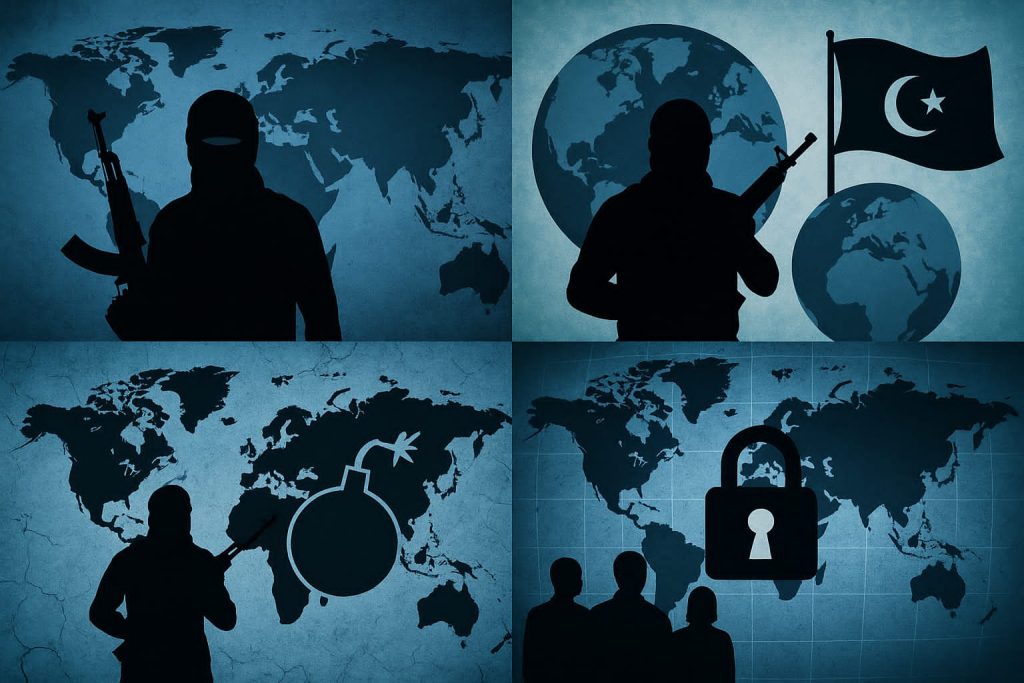
Militant Islamist extremism remains one of the most persistent and adaptive security challenges facing the modern world. It is a threat defined not by a religion, not by ordinary Muslims—who are often its first and most frequent victims—but by violent ideological movements that exploit political instability, digital propaganda, and fractured states to pursue global influence through fear and coercion.
Over two decades after 9/11, the landscape has changed, but the danger has not diminished. If anything, it has diversified.
A Global Network, Not a Localised Problem
Militant Islamist groups—whether emerging from the Middle East, North Africa, West Africa, or Central Asia—operate today through a decentralised model. Organisations such as ISIS affiliates in the Sahel, al-Shabaab in Somalia, and remnants of al-Qaeda across Afghanistan and Pakistan have established durable regional power bases that often outlast government forces.
In regions such as the Sahel, militant factions control vast ungoverned spaces, exploiting porous borders and weak state institutions. In East Africa, the persistence of al-Shabaab highlights how a single group can influence politics, undermine development, and target civilians repeatedly.
The global picture is clear: these groups morph, fragment, and reorganise, but their core ideology—violent extremism under the banner of a perverted and politicalised version of Islamism—remains intact.
Western Nations Are Not Immune
Europe and North America continue to face lone-actor threats inspired by online propaganda. The model has changed: fewer centrally directed plots, more rapid radicalisation cycles fostered through encrypted platforms and algorithm-driven echo chambers.
While security services in the UK, Europe, and the US have foiled countless plots, the risk persists. The Manchester Arena bombing, London Bridge attacks, and assaults in France, Germany, and the Netherlands demonstrate how small cells or even individuals can cause mass devastation with limited resources.
The Human Cost Falls Most Heavily on Muslim Communities
A crucial and often underreported reality is that the vast majority of victims of militant Islamist terror are themselves Muslims. From Nigeria to Iraq, Afghanistan to Somalia, extremist factions routinely target local populations who reject their authority or refuse to conform to their violent doctrine.
This truth underscores what security experts repeatedly emphasise: the fight is not against Islam, but against extremists who weaponise religion as a tool of political control.
Failed States, Fragile Societies, and Digital Radicalisation
Militant groups thrive in unstable environments. The collapse of governance in Libya, the Taliban’s return in Afghanistan, the weakening of civilian institutions in Sudan, and long-term conflicts in Syria and Yemen create perfect conditions for extremist movements to entrench themselves.
Meanwhile, social media has accelerated recruitment. ISIS demonstrated the global power of online propaganda a decade ago, and successor groups continue to push sophisticated narratives designed to prey on disaffected individuals worldwide.
A Challenge That Requires More Than Military Solutions
Military intervention alone cannot eradicate militant Islamist extremism. The most promising approaches combine:
community-based deradicalisation,
robust intelligence cooperation,
investment in local governance,
education and economic opportunity, and
counter-ideological messaging led by credible voices from within Muslim communities.
Governments must recognise that the ideological element—however distorted—cannot be dismissed. It must be confronted thoughtfully, without stigmatising the peaceful, law-abiding Muslim majority.
Conclusion: A Threat That Must Not Be Ignored
Militant Islamist extremism remains a real and evolving threat. It destabilises nations, exploits vulnerable people, and targets innocent communities across continents. But it is not unbeatable, and it does not represent Islam as a religion or Muslims as a global community.
The task before the international community is clear: acknowledge the scale of the threat honestly, support those on the front lines, strengthen societal resilience, and build alliances that isolate and weaken extremist networks.
The world has faced this challenge for more than two decades. We will face it for decades more unless the response is coordinated, intelligent, and rooted in the principles of security and justice.