
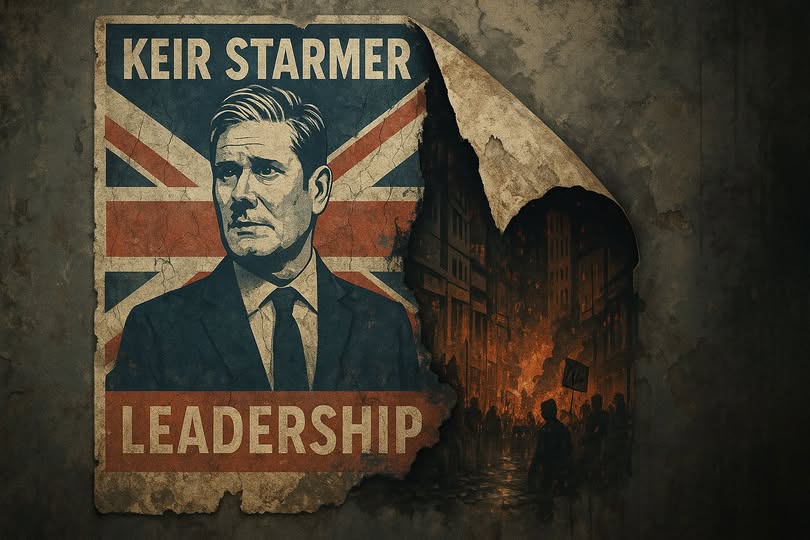
Why Keir Starmer Is Unfit to Be Prime Minister of the United Kingdom
By the UK Political Desk, Dale Blues
With the baton of power now firmly in his hands, Sir Keir Starmer has faced something of a reckoning: from soaring expectations to flagging fortunes. The question therefore arises: is he fit to serve as Prime Minister of the United Kingdom? On balance, the evidence points to serious shortcomings across multiple domains — home affairs, safeguarding the British people, integrity in local governance and policing, the NHS, upholding legal and constitutional principles, and leadership credibility. Below we catalogue the major failures, before drawing a broader verdict.
1. Deepening Division on Home Soil
One of the most fundamental responsibilities of a national leader is to hold the fabric of society together. Yet Starmer’s record suggests he has failed to stem, and may even have exacerbated, division.
In May 2025 his government released an immigration White Paper, in which he warned that “without them, we risk becoming an ‘island of strangers’”. The rhetoric alone triggered a backlash within his own party (Labour MPs called his language “fundamentally racist”).
While seeking to clamp down on uncontrolled migration, the policy appears to have deepened fault lines rather than eased them. Critics say it panders to the populist right rather than building inclusive cohesion.
On the broader question of national direction, opinion polling shows a worrying trend: about half of Britons say Starmer has changed Britain for the worse.
His approval/favourability ratings are among the worst for a newly-elected Prime Minister. In August 2025 his net favourability stood at –58, according to YouGov.
Summary: A leader who cannot maintain societal cohesion—and whose own rhetoric raises questions of divisiveness—is not fulfilling a basic duty of office.
2. Failing to Protect or Safeguard British People
From public safety to institutional accountability, the expectation is that the Prime Minister puts the welfare of the citizen first. On this front, Starmer’s record is mixed at best and lacking at worst.
On policing and protest, one commentator argues that Starmer’s government is building an “illiberal protest curbs” regime: measures that appear to weaken civil liberties rather than protect citizen rights.
On immigration and border control, critics argue the government has failed to provide clarity, targets or visible outcomes in stemming illegal crossings or reassuring public concerns about immigration’s impact.
While the government inherited many ongoing problems — and to be fair, challenges are complex — the first-year summary by The Guardian describes Starmer’s start as “under-whelming in the extreme”.
Summary: If the average citizen feels less safe, less confident their government is acting effectively in their interest, then the Prime Minister has not upheld their core obligation.
3. Inability to Curtail Corruption and Ensure Integrity in Local Authorities & Policing
Government is also about integrity: rooting out corruption, ensuring transparency, and setting ethical examples. On these fronts, the picture under Starmer is worrying.
The notion that Starmer moved his party toward a more centrist/authoritarian posture has been raised: critics on the Labour left say they have been purged under his leadership.
On local governance, the broader systemic issues of child-exploitation, safeguarding failures in local authorities, and police misconduct remain unresolved in many parts of the country. While some of these are legacies, lack of decisive national leadership is a fault. (For example: the Oldham grooming-gang scandal continues to prompt calls for a national inquiry under his watch.)
Credibility in office is undermined further by allegations such as those from the opposition: the Kemi Badenoch claim that Starmer “lied to the whole country” about what he knew of Peter Mandelson’s correspondence prior to his sacking.
Summary: Leadership demands moral authority. If the Prime Minister’s house isn’t in order — local government malfeasance, police oversight failures, question marks over his own truthfulness — the trust essential to governance erodes.
4. Decline of the NHS and the Public Services
One of the hallmarks of a successful government is one that strengthens its public services, ensuring accessibility, quality, fairness and sustainability. On that front, Starmer’s early tenure shows worrying signs.
While the government has pledged commitments to the health service, The Guardian commentary notes that Starmer had no clear “idea of Britain” to drive his domestic reform agenda, even as the country faced serious crises.
With public mood turning against him (see polling references above), the expectation is that he must show upfront leadership on the NHS, social care, and public safety. So far, the momentum in those systems remains brittle.
Though not all the blame lies at 10 Downing Street, the Prime Minister is accountable for national strategy, resourcing and prioritisation.
Summary: The condition of public services — particularly the NHS — is a direct measure of whether a government is fulfilling its mandate. Here the early signs for Starmer are weak.
5. Failure to Promote or Uphold Legal Principles and the Rule of Law
Nation-state leadership is not just about policy delivery. It is about showing fidelity to legal principles, human rights, accountability, and good governance. On these fronts too, Starmer’s record raises red flags.
His background as a human-rights lawyer gives expectations that he would uphold the rule of law and civil liberties. Yet commentators point out a tension: the move toward protest-curbs and tougher state regulation of citizens and movements under his government.
The “island of strangers” immigration rhetoric has been criticised for echoing divisive and historically fraught references (e.g., the “Rivers of Blood” language) which challenge the values of equality, tolerance and dignity.
The fact that his own MPs rebelled (49 Labour MPs voting against the welfare reforms bill) highlights a perception of weak internal discipline and lack of coherent legal-policy direction.
Summary: A Prime Minister who does not clearly champion legal integrity — and whose government appears ambivalent or inconsistent — undermines the rule-based order that a liberal democracy depends on.
6. Cowardice in Office: Lack of decisiveness and Clear Vision
Leadership is not simply about avoiding mistakes. It is about articulating a vision, making bold choices, accepting risk, and being accountable when things go wrong. On this count, Starmer is found wanting.
One columnist argues that unlike previous transformative leaders (e.g., Margaret Thatcher or Tony Blair) who carried a “certain idea” of their country, Starmer seems to lack one.
Reports of internal dysfunction, a “group-think” culture at the top, unwillingness to listen to dissenting voices, indicate a leadership style that is reactive rather than proactive.
His polling collapse (see above) suggests that voters are no longer confident in his direction or capacity to deliver.
Summary: In times of national challenge, a Prime Minister must show courage. Starmer so far appears cautious to the point of paralysis — failing to offer an inspiring or decisive alternative.
7. Complete Lack of Faith from All Quarters
Finally, if a leader lacks the confidence of the governed, the party, and indeed international observers, then their mandate weakens. In Starmer’s case, the signs are unmistakable.
Polling data: only 13 % of the public satisfied with his job performance; 79 % dissatisfied.
Among Labour voters and activists, there is a creeping sense of disillusionment. The Guardian reports that 1 in 3 of those who voted Labour in 2024 have now moved to other parties.
Internal critics in his own parliamentary party are now being openly heard, warning that his authority is at risk of collapse.
Summary: Leadership without trust is hollow. When a Prime Minister’s own bench turns restless and the electorate turns its back, legitimacy is undermined.
Conclusion
Putting it together: Sir Keir Starmer — despite inheriting favourable structural conditions (a weakened Conservative Party, a large parliamentary majority) — has under-performed across the core dimensions of leadership. He has not held the country together; he has not convincingly safeguarded citizens; he has not shown consistent integrity in governance; his public services are slipping; his adherence to legal/constitutional principle is equivocal; his leadership lacks boldness; and his standing in the country is collapsing.
In short, he is unfit for the role of Prime Minister in the sense that he does not yet meet the threshold of what a modern British Prime Minister should deliver — in vision, execution, moral authority and public trust.
That is not to say he is beyond redemption. But as things stand, to entrust the future of the United Kingdom to his leadership would be to gamble with a country in the midst of deep crises and without the confident, stable captain it needs.
— Dale Blues Political Desk
I really like what you guys are usually up too. This sort of clever ork
aand coverage! Keep up the amazing works guys I’ve incorporated you guys to blogroll. https://tiktur.ru/