
COMMENT & SOCIETY
By Jonty Hall
WHY Positive Discrimination Is a Massive Negative in Society
In an age when every institution — from universities to football clubs, police forces to boardrooms — claims to be striving for fairness, it is remarkable how often we drift into something that is anything but: positive discrimination. It is sold as a correction, a remedy, a quick fix. In reality, it is an injustice dressed up as progress.
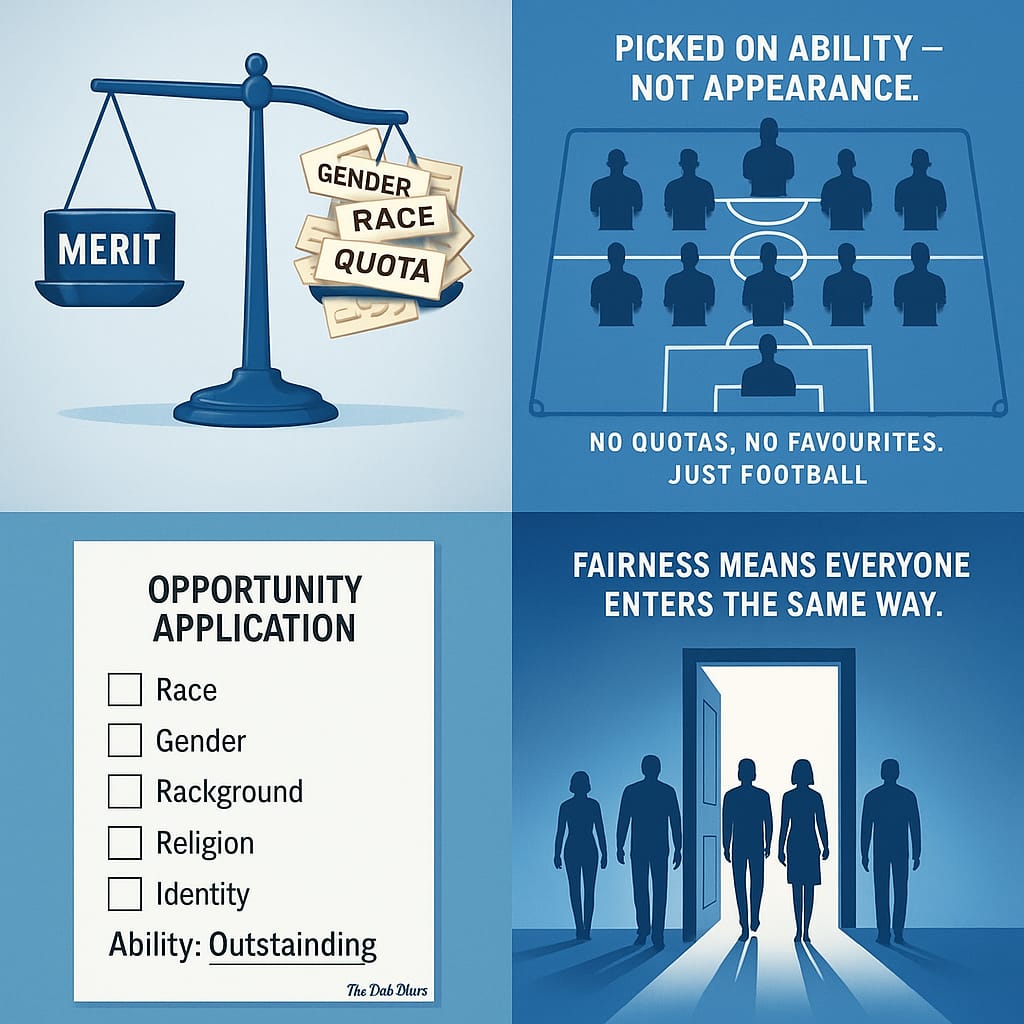
Let’s say it plainly: the only fair system is the one that chooses the best person for the opportunity — not the loudest narrative, not the most convenient demographic, not the most politically fashionable category. The best. On merit. On ability. On character. On work ethic. Anything else corrodes trust.
Fairness Cannot Be Selective
When institutions claim to champion equality but manipulate processes to engineer certain outcomes, they create the very inequality they say they are fighting. It replaces one unfairness with another. Instead of smashing ceilings, it builds new ones — just aimed at different people.
True fairness is blind. It does not sort people by skin colour, gender, background, belief, or sexuality. It does not allocate opportunities as if they were tokens in a political game. Society functions best when opportunity is open to all, but earned by those best suited to rise to it.
The Merit Principle Works — Always Has, Always Will
Merit is not a dirty word. It is the single greatest equaliser ever invented. It means that if you graft, learn, improve, and commit yourself, you have a chance. It means talent matters. It means effort counts. It also means that if you win something, you know you earned it, not because a panel needed to balance a spreadsheet.
When organisations abandon the merit principle, they invite bitterness, resentment, division, and decline. People lose faith in systems that no longer feel honest. And when trust erodes, so does cohesion.
Positive Discrimination Isn’t Progress — It’s Pretence
Positive discrimination assumes that certain groups cannot succeed without special assistance. That is an insult masquerading as empathy. It suggests people are defined by their category, not their capability. Worse still, it reduces individuals to box-ticking exercises.
A society obsessed with categories will never be a society unified by common purpose. We should aim for equality of opportunity, not equality of outcome.
Football Knows This Better Than Anyone
Ask any striker, midfielder, defender, coach, or scout: you pick the player who can do the job. End of story. Not the one who fits a quota. Not the one who looks best on a diversity report. Football is brutally honest because it has to be. If more of society adopted that clarity, we’d solve half our tensions overnight.
Respect Everyone — Favour No One
The antidote to discrimination cannot be more discrimination. Justice must be principled, not performative. Compassion must be sincere, not strategic. If we want a society that feels fair again, we must return to the simple, proven truth:
Treat everyone equally. Evaluate everyone fairly. Choose the best person, every time.
That is not controversial. It’s common sense. And it is the foundation of trust, unity, and genuine equality.
— Jonty Hall, The Dale Blues