
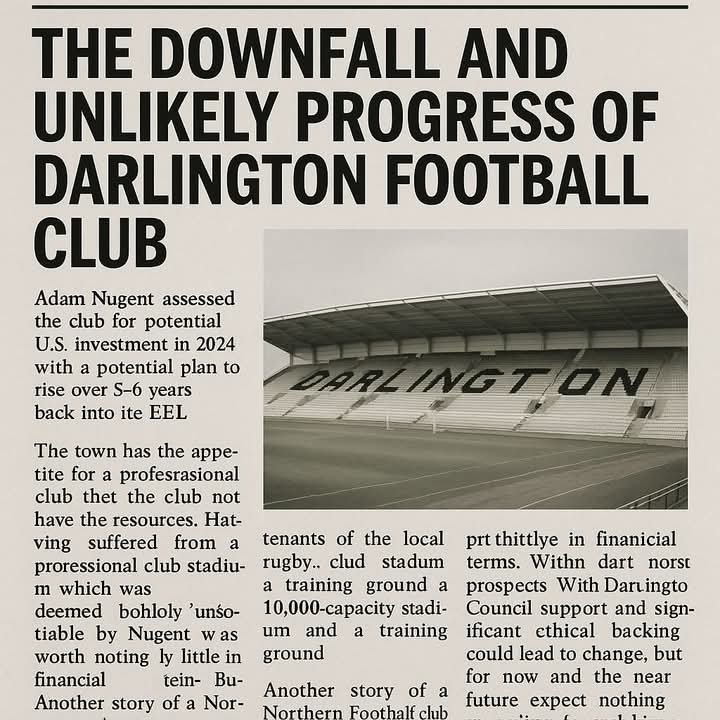
The Downfall and Unlikely Progress of Darlington Football ClubBy The Dale Blues Sports Desk
In 2024, football educator and investor Adam Nugent undertook a professional assessment of Darlington Football Club on behalf of potential U.S. investors, exploring the feasibility of rebuilding the once-proud North East outfit into a modern, sustainable EFL contender. His findings, though rooted in realism, painted a sobering picture of a club trapped between nostalgia and non-league mediocrity.
Darlington FC, a club steeped in over a century of footballing history, continues to exist in a curious limbo — a proud name with passionate followers, but no tangible infrastructure to match its ambition. Once boasting a state-of-the-art 22,000-seater stadium built under the ill-fated George Reynolds era, the ground now stands as a cautionary monument to overreach and poor governance. Nugent’s analysis was blunt: the stadium was wholly unsuitable for sustainable football at any level short of the Championship, both in terms of operating costs and community practicality.
Forced into tenancy at Darlington Mowden Park’s rugby ground, the club now plies its semi-professional trade on borrowed turf. The irony is painful: a town with a genuine appetite for football lacks the facilities, resources, and leadership to support its club’s aspirations. “Darlington has the heart of a professional town,” Nugent observed, “but it’s pumping blood into the wrong system.”
The pathway back to the EFL, as laid out in the 2024 assessment, would demand a purpose-built 10,000-12,000 capacity stadium and a dedicated training facility — both non-negotiable for a sustainable rise. But with current revenues, limited fan investment, and fractious relations with Darlington Borough Council, such a vision remains more fantasy than forecast. The projected costs were simply prohibitive, leaving Nugent’s investors to conclude that the club, in financial terms, was worth virtually nothing.
It’s a familiar Northern tale — a footballing name of heritage and hope, reduced to the margins of the pyramid while lesser-known entities climb through modern planning and sound investment. Darlington, like Bury before them and countless others, finds itself trapped by the ghosts of its own past grandeur.
Could that change? Perhaps. With council support, a modern community investment model, and a new generation of ethical backers who see value beyond balance sheets, the Quakers might yet find a route back to relevance. But for now, and likely for the foreseeable future, expect Darlo to linger mid-table in the National League North, surviving rather than thriving — a reminder that history, without vision and structure, counts for little in the modern game.
For a town that once dreamed of the Championship, Darlington now measures progress in survival. And that, in itself, tells the story of English football’s forgotten middle.