
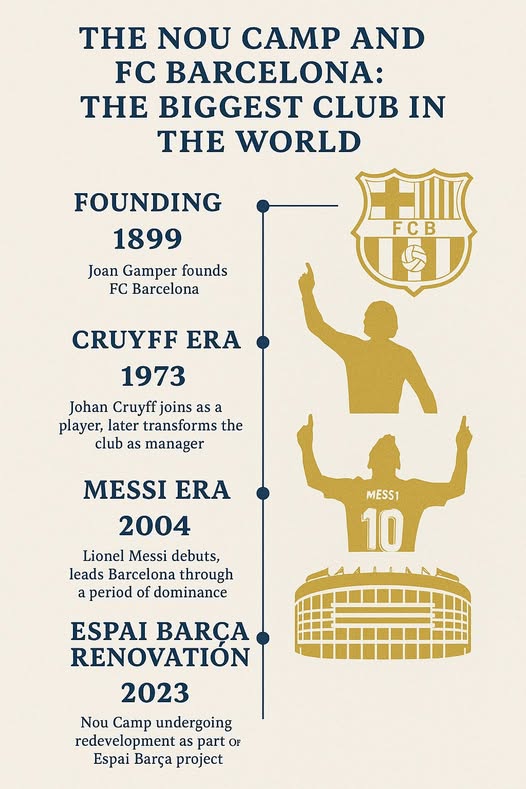
The Nou Camp and FC Barcelona: The Biggest Club in the World
Few stadiums in world football inspire the same awe as the Nou Camp — or Camp Nou in its Catalan form. Opened in 1957 and expanded multiple times since, the stadium stands not just as the home of FC Barcelona, but as a symbol of global football culture. With a capacity that once exceeded 99,000, it has hosted some of the most iconic matches in football history, becoming a cathedral of the beautiful game.
A Club More Than a Club
Founded in 1899 by a group of Swiss, English, and Catalan footballers led by Joan Gamper, FC Barcelona quickly became a force in Spanish football. But its growth went beyond trophies. The motto “Més que un club” — More than a club — reflects its identity as a cultural and political institution in Catalonia. During the dictatorship of Francisco Franco, the Nou Camp became a safe haven where Catalans expressed pride in their language and culture through football.
The Nou Camp Legacy
The Nou Camp’s vast bowl has witnessed eras of greatness. In the 1970s, the arrival of Dutch master Johan Cruyff as a player transformed the club’s playing style. His return in the late 1980s as manager cemented the philosophy that would define modern Barcelona: possession-based, attacking football with intelligence and flair. Cruyff’s “Dream Team” of the early 1990s — featuring stars like Ronald Koeman, Hristo Stoichkov, and Pep Guardiola — lifted the club’s first European Cup in 1992 at Wembley.
From that foundation, the Nou Camp became the stage for generations of global icons. Rivaldo’s overhead kicks, Ronaldinho’s samba smile and brilliance, and Samuel Eto’o’s relentless finishing all graced its turf. But it was Lionel Messi, the Argentine genius, who elevated Barcelona into a dynasty. For more than a decade, Messi made the Nou Camp his canvas, delivering unforgettable goals and winning four Champions League titles between 2006 and 2015. Alongside teammates like Xavi, Andrés Iniesta, and Gerard Piqué, he turned Barcelona into the dominant club side of the modern era.
Global Reach and Identity
With over 140,000 official members, Barça has the largest membership-based ownership structure in the world. This democratic identity ensures the club belongs to its supporters rather than distant investors. Its youth academy, La Masia, has become the gold standard of player development, producing legends like Messi, Xavi, Iniesta, and Carles Puyol.
Commercially, Barcelona is a powerhouse. From shirt deals with global brands to tours across continents, the club has built a fan base that stretches across every corner of the globe. The Nou Camp itself, under renovation to become the Espai Barça project, will evolve into a state-of-the-art complex while maintaining its historical roots.
The Biggest Club in the World
Defining “the biggest club” is subjective, often debated between Real Madrid, Manchester United, Bayern Munich, and others. But FC Barcelona’s case is unique: it combines history, identity, style, and global reach. The Nou Camp remains the largest football stadium in Europe, and Barcelona has consistently blended elite success with a cultural mission unlike any other.
From Gamper’s vision to Messi’s magic, the club has never been simply about winning — it has been about representing a people, a style, and a philosophy that resonates far beyond the pitch. When fans chant “Visca el Barça i Visca Catalunya” under the lights of the Nou Camp, they affirm why Barcelona is the biggest club in the world: it is not only a football institution but a living movement.